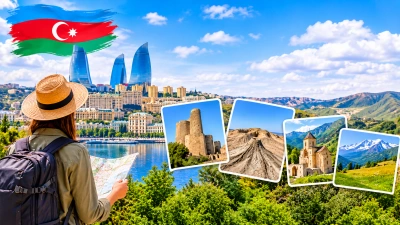
The Caucasian Albania Trail is a unique trekking route that brings together Azerbaijan’s ancient history, mountains, and cultural heritage. Along the trail, visitors can explore ancient settlements, Albanian churches, historic pathways, and the magnificent landscapes of the Caucasus. This route offers a special experience for enthusiasts of Caucasian Albania’s history, mountain hiking, culture, and ecotourism. For those wishing to discover the traces of Caucasian Albania surrounded by nature, this trail is one of Azerbaijan’s most fascinating historical trekking destinations.
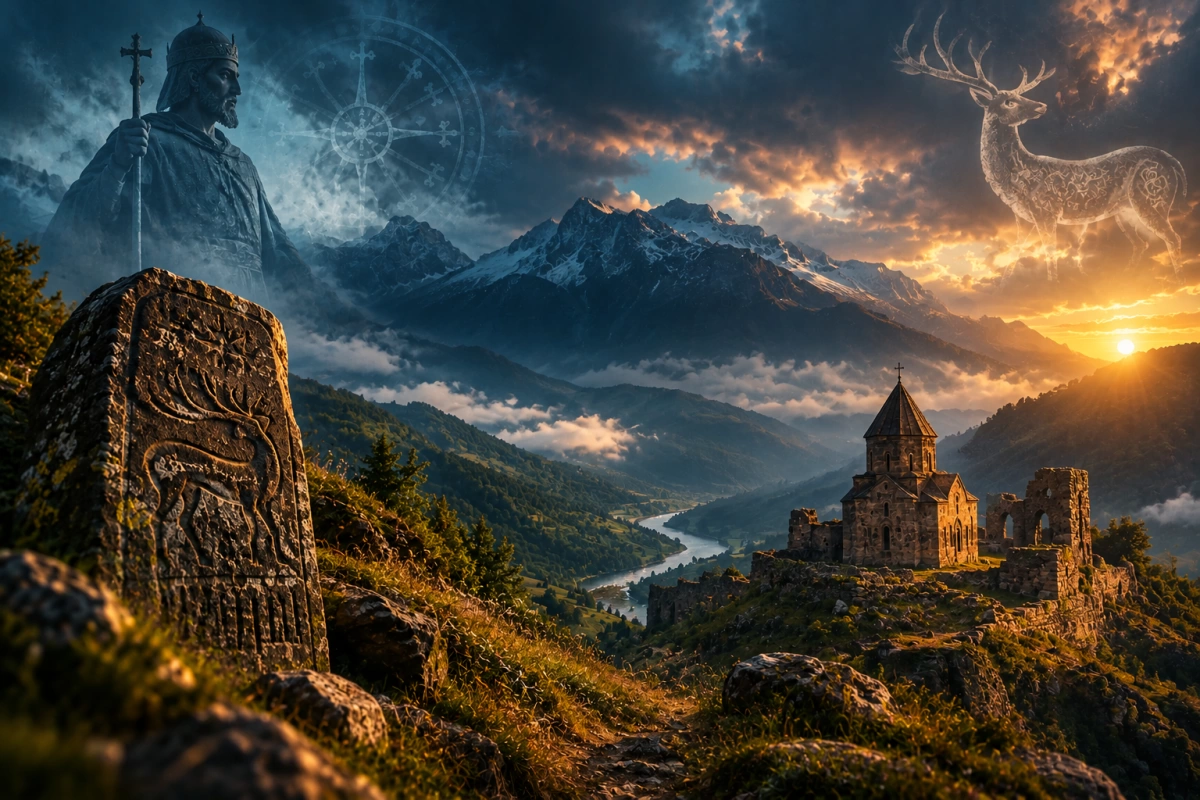
Who Discovered the Albanian Trail?
Who Created the Modern Trekking Route of the Albanian Trail?
The research and development of the modern trekking route of the Albanian Trail is the result of many years of mountain and historical research that I, Babek Iskenderov, have carried out.
However, I do not think it would be right to say, “I created the Albanian Trail.”
Because I did not create these paths.
These are routes that people used hundreds, perhaps thousands, of years before my time. My work has been to search for their traces, investigate the connections between them, map them, and present them to people again as a modern trekking route.
My journey towards this idea did not begin when I started working as a mountain guide.
In fact, it all began in childhood.
Where Did the History of the Albanian Trail Begin for Me?
My interest in Albanian history began in Oraban village, Sheki District, where I was born.
As children, we used to play every day in an area in the upper part of the village known locally as “Yamac”.
There were large gravestones there.
The stones were arranged neatly. We children would sit on them and play. Residents of the upper neighbourhood also used these stones to feed salt to their livestock.
At the time, of course, we did not understand what these stones were or whether they were hundreds or even thousands of years old.
For us, it was simply a place where we spent our childhood.
The years 1990–1998 were my childhood. They coincided with a difficult period when the Karabakh War was ongoing.
Over time, people's perception of that area also changed.
Some time later, local people began referring to the cemetery as an “Armenian cemetery”, and as a result, some of the gravestones were destroyed.
Yet, in my childhood memories, that place had remained an ancient and mysterious site.
There was also an evergreen tree inside the cemetery. One of the gravestones beneath it had an engraving resembling a horseshoe, while another stone bore a carving resembling a bowl or a jar. These details always caught my attention.
At the time, I did not know what they meant.
Later, illegal excavations were carried out in the area, and some people began searching for valuable objects there.
As a result, that ancient place, which had been part of my childhood, was gradually almost completely destroyed.
But the questions remained with me.
“What Was Here in This Village in the Past?”
From the stories told by elderly villagers, we had heard that there were once two churches in Oraban.
It was said that they had also been destroyed over time.
As I grew older, my interest in history began to deepen.
As I read about the Principality of Girdiman, Javanshir, and later Caucasian Albania, the gravestones I had seen as a child, the churches mentioned in village stories, and the ancient traces found in the surrounding areas began to take on a different meaning for me.
I began asking myself:
Who were we before Islam?
Who lived in these villages?
How did they communicate with one another?
Which routes did they use to reach villages on the other side of the mountains?
At that time, I had no idea that these questions would eventually lead me, years later, to the Albanian Trail project.
Mountaineering Opened Another Door for Me
During my university years, and especially after I began practising mountaineering and climbing in 2010, this interest took an entirely new direction.
As I travelled into the mountains, I began discovering remote villages, valleys, mountain passes, and old trails across Azerbaijan.
I realised that studying mountains solely through their peaks was not enough.
The lives of the people living in the mountains, the routes connecting villages, and the ancient mountain passes are also part of the history of this landscape.
In 2016, I founded a small tourism company. In the following years, I began developing nature-based and adventure tourism.
Later, the Campsiz project was launched, and we started organising one-day hiking trips.
One of our first hikes was to Chiraggala, while another took us to Javanshir Fortress, near Talistan village in Ismayilli District.
Visiting Javanshir Fortress was not just an ordinary hiking trip for me.
This time, I was visiting a place associated with the name of Javanshir, whom I had read about since childhood, as a mountaineer and guide.
These hikes became the starting point of an interest that went far beyond nature tourism.
The More I Explored the Mountains, the More Questions I Had
As I travelled to more mountain villages across Azerbaijan, I began gathering increasingly more information.
As I visited villages, spoke with local people, and read historical sources, one thing caught my attention.
Historical sites and ancient religious monuments believed to be associated with Caucasian Albania seemed to be located along a certain corridor across the northern and north-western regions of Azerbaijan.
We came across various historical sites in Sheki, Gakh, Zagatala, Balakan, Gabala, and other areas.
A natural question arose in my mind:
How were these villages and settlements connected to one another?
If people lived in these areas, there must have been routes connecting them.
If trade took place, there must have been caravan routes.
If villages and religious centres were connected, there must have been mountain passes linking them.
Thus, the main question guiding my research became:
Where did the ancient routes connecting sites associated with Albanian heritage pass?
I Began Researching the Albanian Routes in 2017
From 2017 onwards, I began conducting more systematic research in this direction.
First, I started investigating historical sites in Sheki and around Oraban village, where I was born. I studied existing maps and tried to connect villages and historical locations with one another.
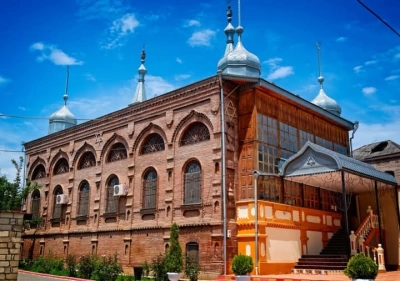
Then I noticed that connections were beginning to emerge between separate pieces of information. I started visiting places associated with Albanian history, such as the Albanian church in our neighbouring village of Kungut, churches in Bideyiz village, and Gavur Fortress in Kaldak.
This led me to an interesting question: could it be that routes connecting these villages had existed throughout history?
An old route mentioned in one village often corresponded with a route remembered in another. When I drew a line on the map, I noticed that certain historical sites appeared to be connected or located close to one another.
This encouraged me even further.
I shared my ideas with several people. However, initially, the concept did not attract much interest. Rather than waiting, I decided to continue working on the maps myself.
Gradually, I began to understand that the villages, historical sites, and old routes I was researching were not isolated pieces of information. There could be a certain connection between them, forming a broader geographical network.
For me, the main objective was no longer simply to find historical monuments. It was to connect these monuments, villages, and routes and understand what kind of movement and communication network had existed across this landscape in the past.
The Roads I Discovered in Gabala
In 2018, I travelled from the Gabala area towards the Demiraparanchay River and Mount Tufandag.
I came across interesting roads carved into the rocky slopes of the mountains.
Their dimensions and structure caught my attention.
It seemed to me that these were not simply walking trails, but roads that may have been used in certain sections for transporting goods and moving carts.
This idea raised several new questions in my mind:
What was transported along these routes?
Where did these roads begin?
Where did they lead?
Which settlement did they connect to on the other side of the mountains?
Could these roads have been part of historical trade networks?
These questions further strengthened my interest in research.
From that point on, my trips to the mountains were no longer just about hiking.
I was looking for roads.
I was searching for traces.
I was examining old mountain passes.
I paid attention to the arrangement of stones, the direction of the routes, and their connections with villages.
The Trip to Derbent
Another stage of this research was connected with our trip to Derbent.
In 2011, I travelled to Derbent with my friend Elnur.
Elnur was a historian and, at the time, was researching Derbent for his master's thesis.
He took me to the Albanian Church in Derbent.
The existence of a monument associated with Albanian heritage within Derbent's famous historical site of Derbent Fortress (Naryn-Kala) was particularly interesting to me.
This visit raised another question in my mind:
If sites associated with Albanian heritage extended from northwestern Azerbaijan all the way to Derbent, what kind of connections existed between the people who lived in these territories?
And most importantly:
Where did the roads connecting them pass?
From Balakan to Derbent...
As my research progressed, I began to develop the following idea:
Perhaps Balakan, Zagatala, Gakh, Sheki, Oghuz, Gabala, and the territories further east were not isolated settlements.
Perhaps they were parts of a much larger historical geographical region.
And if that was the case, there must have been routes connecting them.
I was no longer looking for the road leading to just one village or one historical monument.
I had begun searching for a much larger network of routes.
In 2024, Elnur and I Began Organising This Research
In 2024, I told my friend Elnur about this project.
He welcomed the idea and suggested that we work together to develop the research in a more systematic way.
This collaboration was very important to me.
My research mainly focused on mountains, roads, mountain passes, and trekking routes.
Elnur, meanwhile, began researching historical sources and issues related to Albanian heritage.
In this way, two areas of expertise came together:
Me – mountains and routes.
Elnur – history and historical sources.
This collaboration allowed the Albanian Road project to develop in a more systematic way.
In 2025, based on the results of our research in the Sheki region, we prepared a small book entitled "The Albanian Road".
For us, this book was more than just a publication.
It was one of the first written outcomes of questions that had occupied us for years. Later, this work also led to the creation of the Albanyolu.az website.
How Do We Find the Albanian Road?
In fact, "finding the Albanian Road" is not as simple as finding an ordinary road.
In the mountains, a map alone is sometimes not enough to identify the traces of an old route.
Sometimes, the memories of an elderly person living in a village are far more valuable.
They might say:
"We used to take this road to the summer pastures."
And then you begin investigating that direction.
Sometimes, a shepherd tells you about another mountain pass.
Sometimes, a trail that does not appear on a map can be identified through satellite imagery.
And sometimes, you come across the remains of an old stone-paved road deep inside a forest.
After that, the route needs to be explored on foot.
If it is accessible, I record its GPS track.
I measure the distance.
I record the elevation differences.
I identify water sources.
I check the entrances and exits connecting the route to nearby villages.
I mark dangerous sections of the route.
Then I transfer all this information onto a map.
In this way, the process follows several stages: oral history → map research → field exploration → GPS tracking → trekking route development.
A Road That Does Not Appear on Maps
What fascinates me most is that a road that does not appear on today's maps may once have been essential to people's everyday lives.
Today, there are roads for vehicles.
People travel by car.
But in the past, travelling from one village to another meant walking or riding a horse.
Mountain passes, shepherds' trails, summer pasture routes, and caravan roads were all part of people's daily lives.
Some of these routes have now been forgotten.
However, traces of others can still be found in the mountains.
My goal is to discover and document these traces.
What Is the Albanian Road?
For me, the Albanian Road is much more than just a trekking tour.
It is a project dedicated to exploring Azerbaijan's history on foot.
I want hikers to experience more than just nature when travelling from one village to another.
I want them to discover history along the way.
To visit ancient settlements.
To see monuments associated with Albanian heritage.
To walk along old village roads.
To cross mountain passes.
To meet local people.
To spend the night in traditional village homes.
And to taste local cuisine.
And by the end of the day, they should understand that the route they have travelled is more than just a trail.
This road has a history of its own.
How Far Could the Albanian Road Extend in the Future?
I do not consider the Albanian Road a completed project.
On the contrary, this work is still at an early stage.
There are still many unexplored areas in the mountains of Azerbaijan.
There are roads that do not appear on maps.
There are mountain passes remembered by elderly people but no longer in use.
There are ancient settlements.
There are historical monuments that still need to be investigated.
And I believe there are routes connecting all these places.
My goal is not simply to discover these routes.
It is to:
research them,
explore them on foot,
map them using GPS,
document them,
compare them with historical sources,
and eventually present them to the public as long-distance trekking routes.
I Am Not Creating the Albanian Road
People sometimes ask me:
"Did you create the Albanian Road?"
My answer is:
No. I did not create this road.
What I have developed is the research and organisation of these routes as a modern trekking network.
These roads existed long before me.
Villagers travelled along them.
Shepherds travelled along them.
Merchants travelled along them.
Travellers passed through them.
Perhaps centuries ago, the footsteps of people whose stories we know nothing about crossed these very routes.
I am simply searching for their traces once again.
I am transferring these routes onto maps.
And I want these forgotten roads to come back to life in the future.
What Does the Albanian Road Mean to Me?
As a child, I used to play among the gravestones in Oraband.
Back then, I knew nothing about the history of those stones.
Later, I began reading about history.
I climbed mountains.
I visited villages.
I discovered ancient roads.
I visited Javanshir Fortress.
I saw a monument associated with Albanian heritage in Derbent.
I explored roads in Sheki, Gakh, Gabala, and other mountainous regions of Azerbaijan.
And years later, the questions I had asked myself as a child came back to me:
Who were these people?
Where did they live?
How did they communicate with one another?
Which routes did they travel?
Today, I am searching for the answers to these questions in the mountains.
Perhaps the greatest discovery of the Albanian Road is not finding a new route.
The greatest discovery is realising that the mountains of Azerbaijan still hold an immense history waiting to be explored.
And my work is to discover the routes that are part of that history.