Shirvan National Park is one of the largest protected areas in Azerbaijan and is distinguished by its rich and rare biodiversity. Visitors can observe gazelles, water birds, and other wildlife in their natural habitat. Its location near the Caspian Sea makes it an ideal destination for ecotourism and photography. Shirvan National Park offers nature lovers an unforgettable travel experience.
General Information
Shirvan National Park is a protected area in Azerbaijan and was established on July 5, 2003, by presidential decree. The park was formed on the basis of the Shirvan State Reserve, founded in 1969, and covers an area of 54,373.5 hectares. The territory mainly extends across the Salyan district, as well as the Garadagh district of Baku and the Neftchala district. The park includes flat lowlands located 20–25 meters below sea level on the Shirvan Plain and features a warm semi-desert and dry steppe climate. Hot and dry summers and cool, dry winters are typical. The area is considered an important habitat for biodiversity conservation.
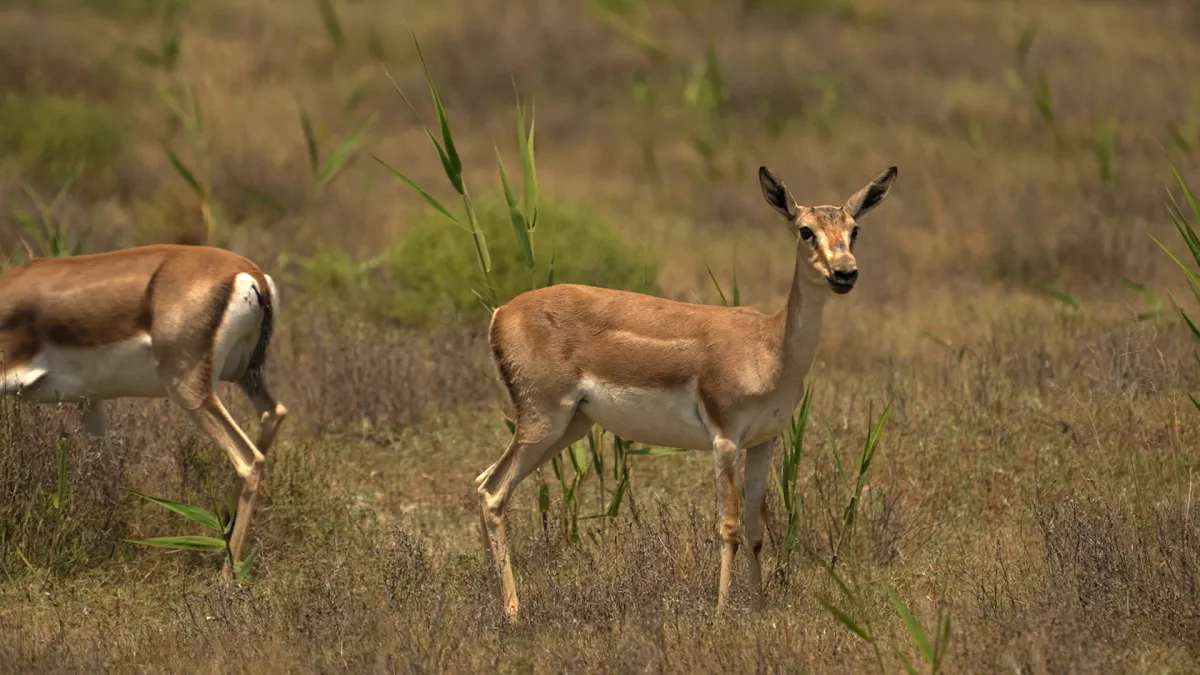
The park is classified as an IUCN Category II protected area. Its main objective is the conservation and population increase of the goitered gazelle (Gazella subgutturosa). Currently, the world's largest population of this species exists here, estimated at over 5,000 individuals in the 2020s. The park also hosts water birds and semi-desert plant species. Its fauna includes amphibians (green frog, lake frog), reptiles (Mediterranean tortoise, Vipera lebetina), birds (peafowl, white-tailed eagle, steppe eagle, saker falcon), and mammals (wild boar, wolf, jackal, wild cat, fox, heron, European hare). Many of these species, including the goitered gazelle, black francolin, and several eagle and tortoise species, are listed in Azerbaijan’s Red Book. The park also protects semi-desert ecosystems and wetlands around Lake Shor, which are important breeding, migration, and wintering grounds for rare bird species.
The vegetation consists mainly of desert and semi-desert species. Approximately 40% of the area is covered by Halocnemum strobilaceum growing on saline soils. Another 40% is rich in salsola, ephemeral broadleaf plants, and grasses such as Poa bulbosa and Bromus. In lowland areas, Alhagi and Aeluropus repens dominate. Due to high groundwater levels in salty areas, Salicornia europaea and other species are widespread. Shirvan National Park is part of Azerbaijan’s key biodiversity network and contributes to nature conservation at both national and international levels.
History and Establishment
Establishment of Shirvan State Reserve
Shirvan State Reserve was established on April 30, 1969, by Decision No.182 of the Council of Ministers of the Azerbaijan SSR. This was one of the main conservation initiatives in the region during the Soviet period. The reserve was separated from the former Bendovan State Hunting Reserve and initially covered about 6,232 hectares in the Salyan and Neftchala districts. In 1982, its area was expanded to 25,800 hectares.
The main goal of the reserve was the protection of the goitered gazelle, water birds, and plant species of the Shirvan Plain. During the Soviet era, conservation of semi-desert environments, increasing rare species populations, and protection from agricultural and hunting pressure were top priorities. The reserve operated under the supervision of the Ministry of Natural Resources of the Azerbaijan SSR, and the use of natural resources was prohibited. In 2003, this area was expanded and granted national park status.
Transformation into a National Park
On July 5, 2003, by decree of President Heydar Aliyev, Shirvan State Reserve was transformed into Azerbaijan’s first national park. The area was expanded from 25,800 to 54,373.5 hectares, incorporating the Salyan district and surrounding territories. This expansion strengthened the protection of semi-desert and wetland ecosystems.
Currently, the park is managed by the Ministry of Ecology and Natural Resources of Azerbaijan and operates under a sustainable conservation strategy.
Geography and Climate
Location and Relief
Shirvan National Park is located in the Salyan district and extends into the Garadagh and Neftchala districts. It lies about 100 km south of Baku, adjacent to the Caspian Sea coast. Coordinates: 39°32′51″ N and 49°00′56″ E. The total area is 54,373.5 hectares (543.7 km²), with water bodies covering approximately 3,500 hectares, including the western part of Lake Shor.
The relief mainly consists of flat lowlands situated 20–25 meters below sea level, covering semi-desert areas of the Shirvan Plain.
Climate
Shirvan National Park has a warm semi-desert and dry steppe climate. Summers are hot and dry, while winters are cool and dry. Annual precipitation ranges between 250–400 mm, mainly occurring in spring and autumn.
In summer, especially in July, temperatures reach up to 40°C with high evaporation. In winter, particularly in January, temperatures range between 0–10°C. These climatic conditions strongly affect soil salinity and vegetation distribution.
Biodiversity
Flora
The park’s vegetation mainly consists of species adapted to semi-desert and saline soils. Halocnemum strobilaceum covers about 40% of solonchak areas. In lowlands, Alhagi and Aeluropus repens dominate, while salsola and Artemisia species prevail in semi-desert zones.
These plants provide the main food base and habitat for goitered gazelles and other wildlife.
Fauna
The park’s fauna is adapted to semi-desert and dry steppe environments.
Amphibians: green frog (Bufotes variabilis), tree frogs (Hyla spp.), marsh frog (Pelophylax ridibundus).
Reptiles: European pond turtle (Emys orbicularis), Caspian turtle (Mauremys caspica), Greek tortoise (Testudo graeca), various desert snakes.
Birds: peafowl, black francolin, white-tailed eagle, steppe eagle, saker falcon, sandgrouse.
Winter migrants: greylag goose (Anser anser), mallard (Anas platyrhynchos).
Mammals: goitered gazelle (Red Book), red fox, wild boar, grey wolf, golden jackal, wild cat, European hare.
Protection and Management
Goitered Gazelle Conservation
Shirvan National Park is the main habitat of the goitered gazelle, hosting over 90% of Azerbaijan’s population. Numbers increased from 130 individuals in 1961 to 4,500 in 2003. Currently, the population is estimated at 6,000–7,000.
Conservation measures include controlled breeding, water supply development, restoration of feeding areas, and protection of semi-desert landscapes. Gazelles are also relocated to other parks to support population recovery.
General Conservation Measures
The park is managed by the Ministry of Ecology and Natural Resources of Azerbaijan and protected by a staff of 43 rangers. Rare water birds such as the marbled teal (Marmaronetta angustirostris) and ferruginous duck (Aythya nyroca) are conserved here.
Protection measures include regular patrols, prevention of illegal activities, scientific monitoring, international cooperation, and ecotourism development.
Name Meaning and Cultural Significance
Etymology
The name “Shirvan” originates from Middle Persian (Shahrabān – “city protector”) and reflects the region’s historical administrative role. In folk etymology, it is associated with the word “shir” (lion), referring to Asiatic lions that lived in the Caucasus until the 10th century.
Historical Human Activity
Historically, nomadic and winter pasture livestock breeding was widespread on the Shirvan Plain. In the Middle Ages, hunting (especially gazelles and lions) was an additional occupation. During the Soviet period, some areas were converted into cotton fields, but the territory largely remained protected as a reserve and semi-desert zone.