Winter mountaineering is one of the most challenging and high-risk forms of mountaineering, requiring serious physical and mental preparation. Snow, avalanche hazards, harsh weather conditions and proper route selection are key factors in ensuring safety during winter mountain hikes. Experience, appropriate equipment and sound decision-making are especially vital when climbing high mountains such as Mount Bazarduzu in winter. This article provides a detailed overview of the main hazards and challenges of winter mountaineering, along with practical recommendations for staying safe.

Introduction
Mount Bazarduzu – Azerbaijan's highest peak (4,466 m) – is considered one of the country's most serious and challenging mountaineering destinations. The nearest settlements to the mountain are Khinalig village in Guba District, Laza village in Gusar District, Gamarvan village in Gabala District, and Kurush village in Dagestan.
The first recorded ascent of Mount Bazarduzu was made by A. Aleksandrov in 1847. A more widely known ascent took place in 1890, when British mountaineer and botanist George Percival Baker (G. P. Baker) and his friend George Yeld reached the summit. These expeditions were primarily undertaken for scientific research and topographical exploration.
After Azerbaijan gained independence and its mountaineering activities became separate from Soviet mountaineering, Azerbaijani mountaineers, under the leadership of Mubaris Rahimov, successfully climbed Mount Bazarduzu on 29 August 1993. In the following years, various sports clubs and organizations began organizing expeditions to the summit.
Several winter expeditions to Mount Bazarduzu were organized over the years, but for a long time none achieved a successful summit. One of the main reasons was that ascents started from Laza village in Gusar District, requiring a long trek on foot. Heavy snowfall in the area repeatedly caused these expeditions to end unsuccessfully.
In subsequent years, the State Border Service strengthened its control over the area, while the mountainous region was also incorporated into Shahdag National Park. This made mountaineering activities even more challenging and introduced mandatory official permit procedures. During the winter months, permits were generally not issued at all.
2017 Caucasus Expedition
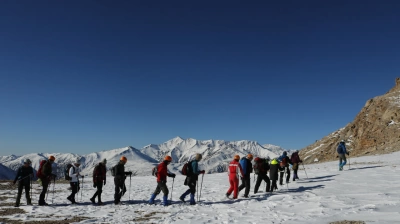
In early February 2017, an international group launched a project called "Caucasus Expedition 2017". According to the expedition plan, a cycling journey starting from the Caspian Sea would continue to Khinalig village. From there, the team planned to climb Mount Bazarduzu on skis, then travel along the Greater Caucasus Range into Georgia, eventually completing the expedition on the Black Sea coast.
Although obtaining official permits for the Azerbaijani section was difficult, it was eventually possible. The Ministry of Ecology and Natural Resources also arranged for me to join the Azerbaijani part of the expedition. My joining point was Khinalig village.
The Journey from Khinalig to Shahyaylag
After completing the organizational work for the national ice-climbing championship held in Laza village on 4–5 February 2017, I headed to Khinalig. The group, which had set off by bicycle several days earlier, arrived in Khinalig on the evening of 5 February.
After reviewing and finalizing the route on the map, we set off from Khinalig towards Shahyaylag on skis on 6 February. Although the deep snow created ideal conditions for the skiers, it presented a serious challenge for me as I was travelling without skis.
A year earlier, during a trip to Mount Bazarduzu with an Austrian group in late March and early April, I had been unable to make further progress in Abil Gorge due to exceptionally deep snow and had been forced to turn back. At that time, the ski group had reached the summit in February via a previously agreed route. Meanwhile, I had to abandon my attempt in the Shahyaylag area because of 1.5 metres of freshly fallen snow.
This time, however, my previous experience, physical preparation and mental confidence gave me additional strength.
Day 1
Our journey from Khinalig to the next stopping point, the Shahyaylag meteorological station, turned out to be extremely challenging. The snow was deep and soft, rapidly draining my energy. At times, I had to spend a considerable amount of time covering just 10 metres. The ski group, meanwhile, was moving comfortably and gradually getting farther ahead of me.
The area we normally use as a vehicle track during the summer months was covered by an exceptionally deep layer of snow. For this reason, instead of following the road, I decided to climb along the mountain ridge towards a pass at an altitude of 2,800 metres. For the group, this section was relatively easy: climbing to 2,800 metres and descending towards Shahyaylag took only 5–10 minutes. For me, however, the same section was both physically exhausting and unpredictable in terms of the time required.
The depth of the snow cover and the route ahead remained constant challenges. After reaching 2,800 metres, I began descending along the mountain ridge. The snow was even deeper in the Shahyaylag area, and there was no suitable ridge left for me to climb along. I realized that reaching the meteorological station would be difficult.
The skiers were making good progress because they did not sink into the snow. I, on the other hand, considered crossing the Shahnabad River, thinking that its surface might be frozen. I put on my crampons and headed towards the stone bridge over the river. Due to the heavy snowfall, I had to cross the Shahyaylag area in a zigzag pattern. Whenever I spotted grass or a small mound protruding above the snow, I knew that the snow was thinner in that spot.
Finally, I reached the Shahnabad River. As I had expected, the river was completely frozen over. Moving cautiously with crampons, I reached the meteorological station in the late afternoon. The snow was so deep that we even had to descend below snow level to enter the station's toilet.
After a short rest, we discussed the plan for the following day. We reviewed the route on the map and decided on our approach. We agreed that, according to the plan, we would make a direct attempt on the summit at 04:00 in the morning.
Day 2
At 05:00 in the morning, we set off towards the summit. It was still dark, and the temperature had dropped considerably. Strong winds and the bitter cold of the night swept loose snow across the surface like dust. The wire fence surrounding the meteorological station, which was approximately 2 metres high, was completely buried under the snow and was barely visible.
Walking on top of the snow was relatively easy, but sometimes the upper layer would break, and I would sink into the snow up to my knees. I tried to follow the tracks made by the ski group. During the night, I had no idea how deep the snow was. The wind was blowing directly against us, significantly slowing my progress.
When I reached Abil Gorge, I thought the conditions would be similar to those of the previous year. And they were. Once again, I sank into the snow. In 2016, I had tried to cover a distance of just 50 metres in this gorge for two hours, but had been unable to get through. In some places, I sank into the snow up to my neck. The day before, while looking through binoculars at Abil Gorge with the late Akif uncle, we had spotted some goats and two wolves roaming the area. The following morning, as I passed through the same place, I became stuck in the snow slightly below the spot where we had seen the wolves.
The area was foggy. I kept thinking that the wolves might appear again at any moment. I could neither move forward nor turn back. The snow seemed to swallow me whole. No matter how hard I pressed down with my trekking poles, they disappeared deep into the snow. It was impossible to make progress, so I decided to turn back. A distance that would take me just 20–30 minutes in summer took me 3–4 hours to cover there and back.
Meanwhile, the ski group reached the summit on 1 April, following the route we had planned. Although they also encountered deep snow in the same area, this time they managed to cross the gorge. By the time I climbed back up, the ski group was already out of sight, and once again I was left on my own.
Higher up, the snow was loose, making progress even more difficult. I began moving in zigzags. It felt as though I were zigzagging across Shahyaylag, covering unnecessary distances and rapidly exhausting my energy. I was losing far more time than I had expected. The sun was beginning to rise, and the stars had already disappeared from the sky.
After approximately two hours of walking, I reached Yatiq River. The skiers were still nowhere to be seen. Here, I had to make my way across the frozen river and continue along a zigzag route. The river concealed dangers that were difficult to spot. The snow was draining my energy rapidly. Some sections of the river were completely frozen, but around the areas where water was flowing, the surface was covered with ice.
After crossing Tufanchay, I continued towards Yatiq, following a zigzag route. The snow had exhausted me considerably. After a while, I spotted the lights of the skiers' headlamps in the direction of the 2,900-metre camp. We were approximately 3 km apart. As I continued along the frozen river, my pace gradually increased.
The wind was strong inside the gorge. I was more worried about the group than about my own safety. However, the group members were more experienced and professional than I was. I followed the river and reached the 2,900-metre point. Beyond this point, more difficult and hazardous terrain lay ahead: a deep, narrow gorge surrounded by avalanche-prone slopes.
After a while, I began sinking into the snow again. Realising that continuing along the river would be dangerous, I headed towards the rocky section on the right-hand side of what is now Mount Zafar. There was less snow there, and the ascent appeared relatively straightforward. Meanwhile, the ski group continued along the route we had agreed on. I thought that once I reached the ridge leading to Zafar, I would be able to follow their tracks.
Climbing over the rocks made things somewhat easier. The snow on the ridge was hard, so I continued using crampons. The higher I climbed, the less snow there was. The strong wind during the night had swept away the soft snow. Higher up, the snow was completely firm.
Psychologically, all kinds of thoughts were running through my mind. Suddenly, I noticed the scent of perfume coming from my backpack. I always carried a bottle with me. When I opened my backpack, I found that it had broken completely. Although I normally dislike the smell of perfume, at that moment it strangely comforted me. I was drinking tea and still had plenty of energy.
Finally, I reached the summit of Mount Zafar and continued along the ridge towards Mount Bazarduzu. At 16:40, I reached the summit. The weather was magnificent — there was no wind, the cold was barely noticeable, and there was very little snow on the summit. However, I was seriously concerned that the ski group had still not arrived.
I planned to wait until 17:00 and then begin my descent. I took photographs and enjoyed the satisfaction of reaching the summit, but my concern for the group remained. I had to make a decision: should I descend along the route I had taken to reach the summit or follow the route we had planned with the group? I knew that descending along the planned group route would be risky. Hoping to catch sight of the ski group somewhere along the way, I began my descent.
The initial part of the descent was relatively easy. However, below 3,800 metres, the snow became deeper and increasingly loose, almost like powder. The lower I descended, the worse the conditions became. With every step, I sank into the snow up to my chest. The snow offered no support and was completely unstable. The situation was becoming dangerous.
By the time I reached the zigzag section, the sun had disappeared behind the mountain. As I was descending along the zigzag route, I suddenly heard a cracking sound. As I moved back, the sound grew louder and extended towards the gorge on my left. I began scrambling away as fast as I could. A moment later, the snow broke away, and a powder snow avalanche swept down behind me. I narrowly escaped being caught in it. The gorge was completely filled with snow.
Moving had become extremely difficult. I had run out of energy and water. Darkness was approaching. Hoping to find water in the lower section of the Yatiq River, I continued descending. When I spotted the ski tracks, I was relieved — it meant that the group had turned back.
It was already evening. Every step through the snow cost me precious time, but I kept going. The moon was beginning to appear. Carefully making my way through the avalanche zone, I finally reached the first camp. This meant that I had left the most dangerous section behind me.
The remaining problem was water. The gorge was completely frozen. Although I could hear running water, everything around me was covered in thick ice. I continued hopefully towards Fakhin's summer pasture, where the Shahnabad River joins the other stream. Near the border post, I finally got a phone signal — the staff at the meteorological station had called me. They said they were coming, and I asked them for just one thing: water.
We finally met near Abil Gorge. They had brought tea rather than water. By then, it made no difference. The most important thing was that the situation was under control. We reached the meteorological station at 00:40 — the following day had already begun.
The ski group was surprised that they had been unable to reach the summit while I had managed to do so alone. There was disappointment on their faces.
The following day, they said they wanted to descend to Gabala via the Kurve mountain route. I objected — there was too much snow, and the avalanche risk was high. They did not listen to me. They left the station at 05:00 in the morning but returned a short while later. The snow conditions were simply too severe.
Thus, we completed this part of the trek and decided to return to Baku. Later, the Ministry of Ecology, where I worked, and the Federation of Air and Extreme Sports did not give me permission to set off again. The group, however, went on to complete the expedition.
Reaching a remote, challenging summit alone in winter, one that few people had attempted during that season, was an incredible feeling. Unfortunately, following the tragedy on Mount Tufandag in December of that year, winter mountaineering activities were no longer permitted, and all my winter plans were postponed.
The Dangers and Challenges of Winter Mountaineering
Winter mountaineering is about much more than simply climbing a mountain. It is about confronting your own limits. Trails that are familiar in summer disappear under the winter snow; the ground gives way to snow, and silence gives way to sound. Snow, wind and cold test not only your body but also your mind. In winter, the mountain does not let you pass — it tests you.
This expedition once again taught me that winter climbing requires more than physical strength. It demands sound judgement, patience and the ability to make the right decisions.
The Deceptive Nature of Snow
In winter, snow can sometimes look like a firm, reliable surface. You take a step, and everything seems fine. But a few metres later, the upper layer breaks, and you sink into the snow up to your knees, sometimes your chest or even your neck. Snow silently swallows you. Especially in gorges and areas sheltered from the wind, snow depth can vary dramatically between night and day. Tracks made during the night can seem to have disappeared completely by morning.
In moments like these, you realise that in winter, snow is not your friend — if you cannot read it, it can become your enemy.
Avalanche Risk
When winter climbing is mentioned, the first danger that comes to mind is an avalanche. However, an avalanche does not always arrive with a roar. Sometimes, the sound of a single crack or a slight vibration beneath your feet is enough. Powder snow, a hard underlying layer, and wind-loaded snow can suddenly begin to move in a matter of seconds.
There is no escape in narrow valleys. One wrong step can be fatal. In avalanche-prone terrain, you should no longer be thinking about the summit, but about finding a safe way out.
Limited Visibility and Disappearing Routes
In winter, the mountain becomes unrecognizable. Terrain you know by heart in summer disappears beneath the snow. Fog, darkness, and snowfall can take away your sense of direction. GPS, maps, and a compass can help, but they cannot solve everything. Experience and instinct are essential.
Sometimes you stop, look around, and realize that the mountain is testing you: "Will you continue, or will you turn back?"
Cold, Wind, and the Struggle for Energy
In winter, every step requires twice as much energy. Moving through powder snow, maintaining balance on hard snow with crampons, and pushing forward against the wind all drain your energy. But the greatest dangers are dehydration and exhaustion. Thirst and fatigue impair your ability to make sound decisions.
At such moments, you are no longer moving forward with your body, but with your willpower.
Being Alone and the Psychological Burden
There is silence in the winter mountains. A silence so deep that you can even hear your own breathing. When you spend long hours alone, your mind begins to talk to you. Fear, doubt, and questions arise...
– Should I continue?
– Should I turn back?
– Do I have enough time?
Being alone can make you stronger, but it can also break you. In winter, psychological resilience becomes even more important than physical strength.
Moving in a Group, Climbing Alone, and the Risks
Climbing alone in winter means multiplying the risks several times over. Breaking trail, making decisions, and having to correct your own mistakes can be exhausting. Even when moving in a group, differences of opinion, varying speeds, and route choices can create problems. However, in a group, responsibility and risk are shared, whereas when you are alone, everything falls on your shoulders.
Knowing When to Turn Back
In winter climbing, reaching the summit is not the main objective. The real goal is to return safely. Turning back when the weather changes, the snow becomes heavier, or the climb takes longer than expected is not an act of cowardice — it is professionalism. Winter mountains do not forgive haste.
The mountain will always be there. You may not.
What This Expedition Taught Me
This climb reminded me once again that:
-
Every decision in winter comes at a price
-
Reading the conditions is more important than following the route
-
Being alone can make you stronger, but it also involves greater risks
-
Sometimes, turning back is the greatest achievement
For Those Who Want to Climb Bazardüzü in Winter
This mountain is not for everyone in winter.
For those without sufficient experience, with limited avalanche awareness, or inclined to climb solo, Bazardüzü in winter is a closed door.
But for those who are well-prepared, experienced, and approach the mountain with respect, it is a school where you learn more about yourself.
Winter climbing is not about romantic photographs. It is about silence, fear, decisions, and responsibility. This expedition once again showed me that the mountain does not judge you by whether you reach the summit, but by how you conduct yourself along the way.
The mountain puts you to the test.
The summit is simply the answer you give at the end.