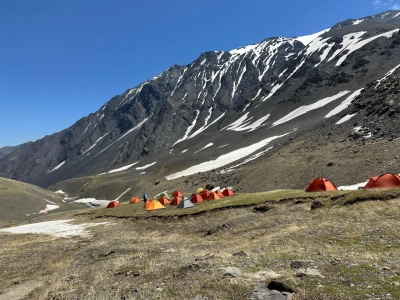
One of the most dangerous risks when staying in a tent is carbon monoxide poisoning. This gas is colourless and odourless, making it impossible to detect with your senses. It can quickly accumulate in enclosed spaces and become life-threatening. Carbon monoxide is mainly produced when stoves or gas-burning equipment are used inside a tent. To stay safe, always cook outdoors and ensure proper ventilation around your tent.

Carbon monoxide (CO) is a gas that you cannot detect with your senses — it has no smell, colour, or taste. However, its danger is very real. When you breathe it in, it enters your bloodstream and interferes with the blood's ability to carry oxygen, depriving vital organs — especially the brain and heart — of the oxygen they need. This process often begins without obvious warning signs, with early symptoms such as headaches, weakness, dizziness, and nausea.
The most dangerous aspect is that these symptoms are often not taken seriously. People may mistake them for fatigue, a cold, or general weakness. Meanwhile, carbon monoxide continues to build up in the body, and its effects become increasingly severe. Without a timely response, poisoning can lead to loss of consciousness, brain damage, and death.
This risk is even greater when camping in a tent. When a stove or gas-burning appliance is used, carbon monoxide can accumulate rapidly, especially in enclosed or partially enclosed spaces. Even cooking in the vestibule of a tent cannot be considered completely safe — the gas can gradually enter the sleeping area, where you may breathe it in without realising it.
Cases of carbon monoxide poisoning resulting in deaths at campsites and in tents are reported every year. This demonstrates that the problem is not rare and represents a genuine danger.
The safest approach is to prepare food outdoors. This significantly reduces both the risk of carbon monoxide poisoning and the likelihood of fire. However, mountain conditions do not always make outdoor cooking possible. Strong winds, rain, or cold weather may sometimes force people to cook in a tent vestibule or a dedicated cooking tent.
In such situations, it is important to follow several safety rules: ensure maximum ventilation and never lie down or go to sleep while a stove is operating. One of the most dangerous situations is falling asleep while a stove is running, as you may be poisoned without realising what is happening.
Carbon monoxide is particularly dangerous in mountainous environments because oxygen levels are already lower at high altitudes. This can make the effects of oxygen deprivation even more serious. For this reason, the risk of CO poisoning should be treated as seriously as natural hazards such as avalanches, falling rocks, or cliffs.
For additional safety:
-
Never use a stove inside a fully enclosed tent.
-
Remember that a tent vestibule is not necessarily a safe place to cook.
-
Check gas appliances before every use.
-
Never use a stove to heat your tent.
-
Use a portable carbon monoxide detector if suitable for your camping setup.
-
Establish a clear supervision system when cooking as a group.
-
If anyone develops a headache, weakness, dizziness, or unusual drowsiness, move everyone away from the suspected source and into fresh air immediately. Seek emergency medical assistance.