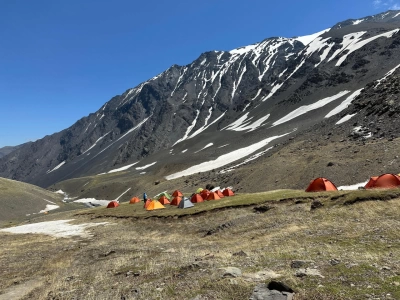
Mountain Ethics teaches climbers and mountaineers to respect nature and other people. Personal responsibility, team spirit, and safety principles form the foundation of every activity. Showing respect for different cultures abroad and following local climbing ethics are essential. Leaving no trace in the mountains and protecting nature is the duty of every mountaineer. By following these principles, the beauty of the mountains is preserved for future generations.
With amendments adopted in the city of Porto on 10.10.2009
Push your limits, elevate your spirit, and move forward toward the summit
1. Personal Responsibility
Mountaineers and climbers operate in environments where help is not always available and the risk of accidents exists. For this reason, they undertake these activities at their own responsibility and are accountable for their own safety. An individual’s behavior must neither endanger others nor harm the environment. For example, placing anchors on new or existing routes is not automatically considered acceptable.
2. Team Spirit
Team members should be ready to compromise in order to consider the needs and abilities of everyone in the group. A climb or hike is most successful when team members support and motivate each other.
3. Mountaineering and Climbing Community
Every person we meet in the mountains or on the rocks deserves the same respect. Even in remote areas and stressful situations, we should treat others as we would like to be treated ourselves.
4. Traveling Abroad
When traveling as guests to foreign countries, we should behave politely and respectfully. We must respect local people and their culture — they are our hosts. We should observe local climbing ethics and styles and avoid drilling or bolting in areas that go against tradition or where ethics are not clearly defined. Sacred places and mountains should be treated with respect, and we should look for ways to contribute positively to the local economy and communities. Understanding foreign cultures is an important part of the climbing experience.
5. Responsibility of Mountain Guides and Other Leaders
Professional mountain guides, other leaders, and members of the groups they lead must clearly understand their roles and respect the freedom and rights of other groups. This declaration recognizes the high professional standards of mountain guide associations.
6. Emergencies, Injury, and Death
Emergencies, serious accidents, and the risk of death are integral parts of mountain activities. Therefore, everyone involved in mountain sports must understand the risks and possess appropriate skills, knowledge, and equipment. They should also be prepared to help others and to face the consequences of tragedy. Commercial operators, in particular, are expected to inform their clients in advance that their goals may remain unfulfilled in order to assist in rescue efforts.
7. Access and Nature Conservation
We believe that responsible access to mountains and rocks is a fundamental freedom. To protect nature and landscapes, we must always act in an environmentally sensitive way. We should respect agreed access rules and restrictions established between climbers and conservation organizations.
8. Style
In climbing, the quality of the experience and how a challenge is overcome are more important than the result. Leaving no trace on rock and mountain surfaces should be our shared goal.
9. First Ascents
The first ascent of a route or mountain is considered a creative activity. This process should be carried out in accordance with the traditions and climbing style of the region. The manner in which the ascent is completed must be documented with full accuracy.
10. Sponsorship, Advertising, and Public Relations
Cooperation between sponsors and climbers should be professional and serve the interests of mountain sports. The mountaineering community should actively and accurately inform the media and the public.
11. Use of Supplemental Oxygen in Mountaineering
The use of supplemental oxygen in high-altitude mountaineering has long been a subject of debate. Medical and ethical aspects differ on this issue. Medical factors should be the primary concern for all climbers. Ethical considerations are a personal decision for each mountaineer — however, if oxygen is used, the removal of empty cylinders from the mountain must be planned.
12. Commercial High-Altitude Expeditions
Operators who organize ascents, especially to 8,000-meter peaks or summits with limited rescue possibilities, are expected to properly assess the abilities of their clients. All measures must be taken to ensure their safety, and clients must be informed in advance that plans may change in order to assist those in need on the mountain.
Source: https://www.theuiaa.org/mountain-ethic-declaration/