Ski difficulty levels help you choose routes that match your skills and experience. From beginner to expert levels, different slopes require varying speeds and turning techniques. Knowing your level ensures safety during lessons and helps speed up the learning process. By choosing the right level, you can get the maximum enjoyment from your skiing experience.
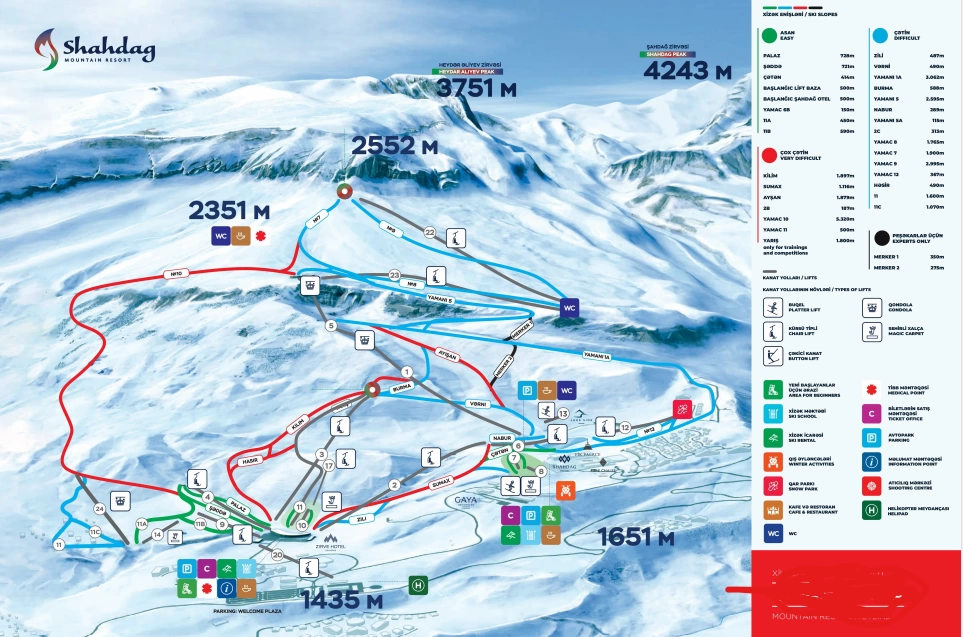
Knowing all the different colors and symbols that represent run difficulty can greatly increase your enjoyment on the mountain and help keep you safe. Let’s take a look at what the different ski levels are, what they mean, and how to tell them apart.
A common misconception among new skiers is that difficulty ratings are the same at every resort. This is false; a run’s difficulty is based on how technically challenging it is compared to other runs on the same mountain.
Ski Difficulty Ratings in Azerbaijan
These are the five most common difficulty levels used at ski resorts in Azerbaijan. They show how easy or difficult runs are relative to each other on the same mountain, but they are not consistent between different mountains.
1. Beginner / Easiest 🟢
This level is represented by a green circle and marks the easiest terrain on any mountain. These runs feature gentle slopes, short distances, and usually well-groomed snow.
For new skiers:
These runs are for skiers who:
-
Have never skied before
-
Have only skied a few times
-
Have not skied for a long time
-
Prefer slow speeds
-
Prefer wide open runs
Regardless of experience, these runs are ideal for warming up at the start of the day. It’s important to get your blood flowing and stretch your muscles before moving to more difficult terrain.
2. Intermediate 🟦
These runs are marked with a blue square and are slightly more technical than beginner terrain. Expect steeper slopes (less than 30°), longer runs, and more variable snow conditions, as these runs are groomed less frequently.
These runs are suitable for skiers who:
-
Have taken at least a few lessons or ski days
-
Want to build confidence skiing on snow
-
Want to improve technique on moderate slopes
-
Want to try skiing through lightly spaced trees
3. Advanced 🔴
Marked with a red diamond, these runs can include 30–40° slopes, rocks, moguls, and dense trees. They are significantly more dangerous than the previous two levels and are not suitable for beginners.
These runs are suitable for skiers who:
-
Have years of experience
-
Enjoy steep slopes
-
Enjoy skiing through trees
-
Enjoy large moguls
-
Are comfortable catching air
4. Expert Only / Extremely Difficult ⬛
These runs are marked with double black diamonds and may include exposed terrain. They are intended only for the most experienced skiers on the mountain.
Due to their steep angles, these runs are rarely free from avalanche risk. Large drops, open faces, and 40°+ slopes are common.
These runs are suitable for skiers who:
-
Have many years of skiing experience
-
Enjoy frequent airtime
-
Can handle unpredictable conditions
-
Are comfortable skiing at high speeds
-
Enjoy skiing through dense trees
-
Can visualize their line before dropping in
5. Terrain Park 🟠
Terrain parks are shown with a yellow/orange oval on signs and maps. These areas are designed for freestyle skiers who enjoy jumps, rails, boxes, and other features.
The size and technical difficulty of terrain parks vary by mountain and even within the same resort. Some parks have small features for beginners, while others include professional-level features.
Beginners are advised to avoid these areas.
Special Variations:
Some more specific symbols are occasionally used to show terrain difficulty. While rare, they are useful to know:
-
Easy-Intermediate: A blue square inside a green circle shows terrain between beginner and intermediate.
-
Intermediate-Advanced: A black diamond inside a blue square shows terrain for intermediate to advanced skiers.
-
EX, Orange Diamond, Triple Black Diamond: Used mainly in Colorado and Montana for extreme terrain with 50°+ slopes and avalanche risk.
How to compare difficulty between mountains?
Comparing difficulty across mountains is hard because there is no universal standard. Eastern mountains tend to be smaller and less steep than western ones. When visiting a new resort, start with easier runs than you’re used to for safety. This gives you time to learn the layout and avoid terrain beyond your skill level.
Conclusion:
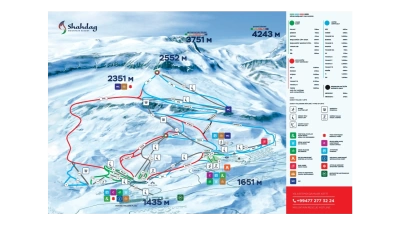
Knowing the five main difficulty ratings is essential. Skiing beyond your ability can endanger you and others. Remember, ratings vary from mountain to mountain. Always review the trail map when traveling to new destinations.
You can contact us for rental equipment and clothing: Ski Clothing and Equipment Rental